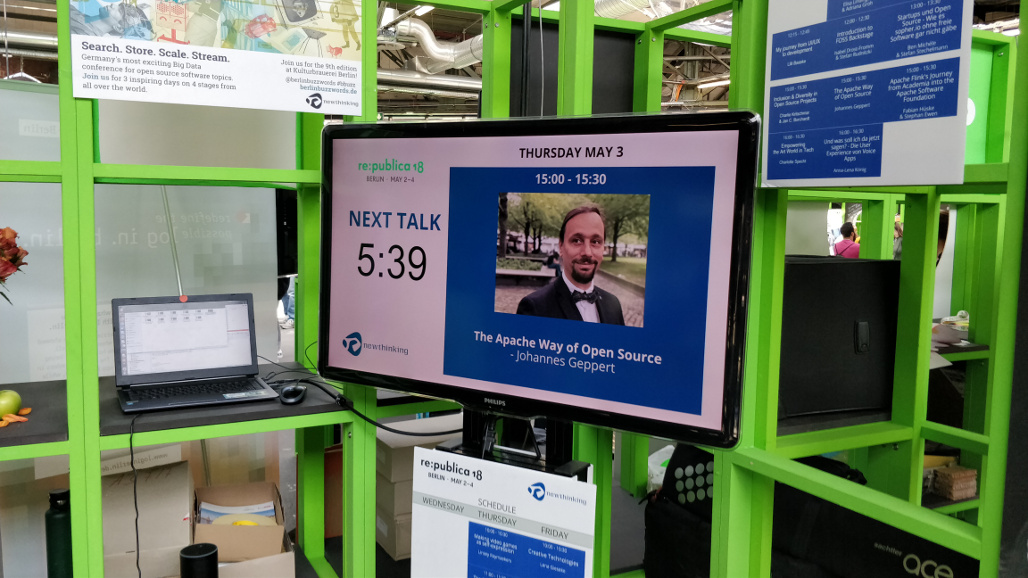
In May 2018 I spoke at re:publica in Berlin for the first time. Newthinking invited me to give a short talk in their exhibition program about The Apache Software Foundation and how its projects govern themselves.
The slides are on SlideShare:
What the Apache Way means
The Apache Software Foundation hosts more than 350 projects, from the HTTP Server to Kafka and Spark. None of them belongs to a company. What holds them together is a small set of principles the foundation calls the Apache Way.
Earned authority. Influence comes from what you contribute, not from your title or your employer. It stays with the person, and it doesn’t carry over from one project to the next.
A community of peers. Individuals take part, not companies. Every vote counts the same, whoever pays the person casting it.
Open communication. Decisions happen on public mailing lists, where anyone can read them years later. Inside the foundation there’s a short rule for it: if it didn’t happen on the list, it didn’t happen.
Consensus. Most questions settle through discussion. Votes are for the things that need a binding answer, such as a release.
Independence. No company can buy control over a project’s direction, whether it employs committers or sponsors the foundation.
All of this rests on the foundation’s motto, community over code. A project only outlives its first authors if the people around it can work together.
When I gave this talk, the common word for the first principle was meritocracy. The foundation now calls it earned authority, which I find more precise: authority here is something you build through your work, not a rank you hold.
Eight years later
I’ve been on the Apache Struts PMC since 2009, and for the past years I’ve also led engineering teams. Two of these principles came with me.
The first is writing decisions down. A decision that only exists in a meeting fades when the meeting ends. One that’s written where the team can find it can be questioned, and found again two years later.
The second is that influence should follow contribution. Whoever does the work on a topic should shape it, whatever their title. In a team with levels and titles that takes a manager who deliberately hands the topic to that person.
More about my work in open source is on my About page.